
By Jacqueline T. Lynch, Vice President
July 4, 1826, was the 50th anniversary of the signing of the Declaration of Independence.
There were 24 states in 1826. John Quincy Adams, son of our second President, John Adams, was President.
That day saw the remarkable coincidence of former President John Adams, and his successor in office, Thomas Jefferson, both dying on July 4th. Adams survived Jefferson by only hours. There was only one original signer of the Declaration of Independence left: Charles Carroll of Maryland, who would live another six years.

The 25 years since the 1801 anniversary saw the largest loss of our remaining Revolutionary War veterans in Chicopee, some 19 men. We are including not only those born here, but those who settled here after the war. Chapins, mostly, of course, men who were brothers, cousins, uncles, second-cousins, but also a few other families. Phineas Steadman; Caleb Pendleton, Jr.; Gad Horton; John Frink, Jr.; and Ariel Cooley, whom we mentioned last week, were among those who passed. Still, over a dozen Revolutionary War vets remained.
We were moving well past the Revolutionary era; even Daniel Shays, who had sparked Shays’ Rebellion in 1786-1787 had died, in poverty, in New York State the previous year of 1825. He had long since been pardoned for his part in the rebellion and been granted a military pension for his service in the Revolutionary War, his main support in his old age.
Chicopee was now part of Hampden County, which was created in 1812, but we were still the northern part of Springfield at this time. But the town was on the cusp of change.
The first great cotton mill was completed the year before in 1825 in Chicopee Falls; the third mill of what would become the Chicopee Manufacturing Company was erected in this year of 1826 by industrialists from Boston. The Falls would soon become known as Factory Village before it ever took over the “Chicopee Falls” identity. The dam was completed, the brick workers’ housing was up – we’d later refer to that area as Chinatown – and the river which had sustained the native peoples now brought power to the beginnings of the Industrial Revolution.
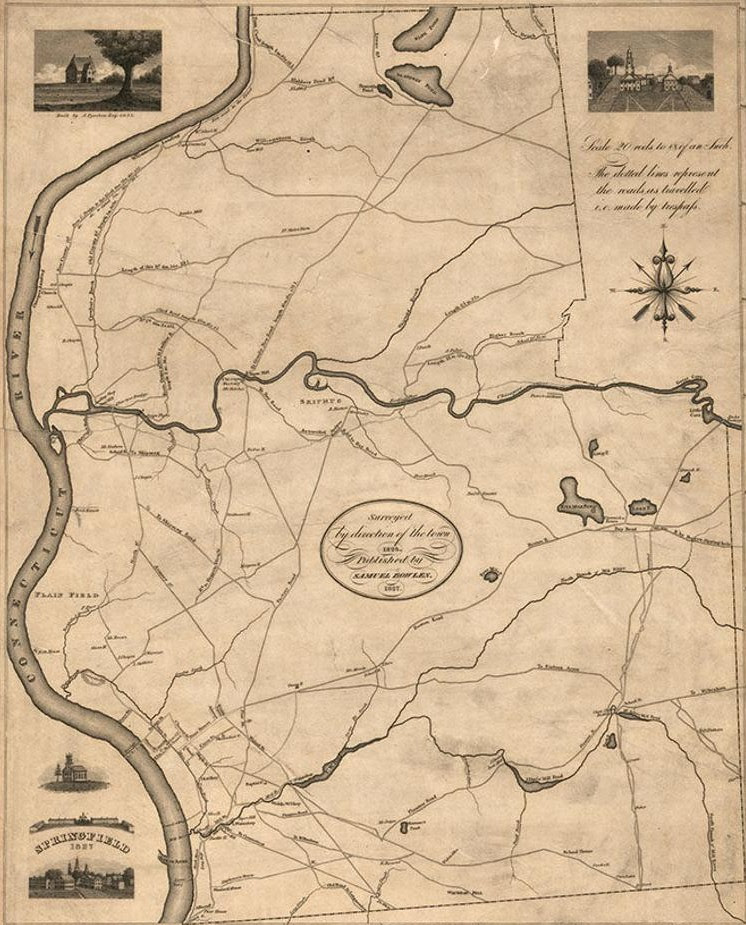
Cabotville would be so named when that section of town likewise was taken over for development by industrialists, but you can see on this 1827 map there still weren’t too many roads carved out, nothing to resemble the web of streets that would start in the next couple decades. It was still as wild as most sections of Chicopee.

But we became adventurous and pushed through a few long country roads through what had been marked as “Pine Barren” in Fairview and Aldenville. Most of them started as Indian paths. You can see what would be Granby Road now meandering through Sandy Hill and connecting with what would be McKinstry Street eventually, and leading off into Fairview and Ludlow and Granby beyond, which is why it was called Granby Road. A road was not named as often as it was “to” someplace: “To Granby,” “To Ludlow,” “To Bay Street.” Sometimes a prominent citizen’s home would be marked. You can see “Capt. Griswold” in Willimansett. He was Joseph Griswold, who enlisted at 19 and served at Boston and marched to Ticonderoga and White Plains, and drove a team for the Northern Army in New York . He would die a few years’ hence in 1829 at the age of 73.

In addition to the Congregational Church on Chicopee Street, there was now a First Methodist Episcopal Church organized in 1822 in a meeting room; their first church building would be constructed in 1829. Congregational services were held in one of the homes of the Belcher family in the Falls as early as 1822, but it would be two more decades before a church was constructed as the Second Congregational Church.
It is likely that in this northernmost half of Springfield on July 4, 1826, the Semi-centennial of our nation’s founding, that the Declaration of Independence would be read aloud by a prominent citizen. It was not yet a day for fireworks or parades as we know them (a stately and small procession of speakers was usually in order), but it was customary for the community, or as many as who could come, to gather for a dinner, following which toasts would be drunk to the United States, to the Constitution, to the President, to Our Pilgrim Fathers, to Massachusetts and Governor Levi Lincoln.

In Chicopee, this might have occurred outside in a grove, or in a tavern, like Abel Chapin’s on Chicopee Street. Landlord Abel, one of those remaining Revolutionary War vets, was 70 years old this year. The bill of fare did not include burgers and hot dogs. More than likely, it would have featured shad and salmon, both of which flourished in the Connecticut and Chicopee rivers. Oysters might be obtained from the coast. Lots of boiled potatoes and local vegetables, spring or early summer crops. They did have beer, though, and hard cider. Lots of it.
A July 4th gathering that year in Northampton, according to the Hampshire Gazette, raised a glass to “the Surviving Officers and Soldiers of the Revolution.”
Come back next week for a look at the 75th anniversary of the Declaration of Independence – July 4, 1851.
Sources:
Chapins Who Served in the French and Indian Wars 1754-1759; The Revolutionary War 1775-1783, the War of 1812, 1812-1815, and Others, complied by Charles Wells Chapin, (Springfield, MA, 1895).
Digital Commonwealth website, 1827 map of Springfield published by Samuel Bowles.
Find a Grave website.
Hampshire Gazette, July 12, 1826.
Massachusetts Soldiers and Sailors of the Revolutionary War (Boston: Massachusetts Office of Secretary of the State; Wright and Potter Printing Co., State Printers, 1896).
McKinstry, Winthrop. Glimpses of the Past. (Chicopee, MA; 1978).
Shlakman, Vera. Economic History of a Factory Town – A Study of Chicopee, Massachusetts (NY: Octagon Books, rept. 1969)
Szetela, Thaddeus M. Chicopee (Chicopee, MA: Szetela & Rich Publishing Co., 1948).
***
The Chicopee Historical Society is currently looking for a new treasurer. Anyone interested in applying for that position on our board of directors may contact us here.
Leave a Reply